The Rise of the Equestrian Super-Yard

A growing demand for elite European-standard training establishments is reshaping the professional British equestrian property market. Katherine Watters, our equestrian specialist and Partner in the Southern Home Counties, explains why, and what buyers need to take into consideration.

Portrait of a sports brown horse with a white groove on the muzzle in the bridle. Dressage of horses in the arena. Equestrian sport.

When people think of “equestrian property”, many picture a country house, a few paddocks and a row of stables. But alongside that, another market has been stealthily growing, and it is the one I am increasingly asked to help with: the professional training establishment. These ‘super-yards’ are built around the training of elite horses and riders – more about the horses and less about the main house. This has been fairly mainstream throughout the racing industry for years, but now it is growing within other equestrian disciplines.

When I work with clients planning a professional yard here in the UK, it’s clear how much the bar has risen. People now require a level of sophistication in the facility that is a world away from what it was a generation ago, influenced by the European model. And buyers’ expectations have shifted dramatically as a result.

From standalone yards to equestrian training establishments

Go back to the 1970s and 80s and professional yards were far more basic. Riders trained where they could, often on grass in a field or out hacking, and a good yard might have a sand school but little more. Today this has changed and with the majority of national and elite dressage and jumping competitions being held on specialist all-weather surfaces, demand for sophisticated facilities at home have evolved. This shift has been driven by comprehensive sports science, strict FEI guidelines, and an overriding commitment to equine welfare. Grass arenas are still found at county shows and at famous venues such as Hickstead in West Sussex, and CHIO Aachen, and Derby Park in Klein Flottbek, Hamburg, but it is no longer the norm. This has fundamentally changed what a professional training base needs.

Ten or 12 stables and a manège used to be considered a comprehensive equestrian facility. Now, I am asked for indoor stabling with integrated individual outdoor areas, and almost campus-like barns. These house not only stables but also wash-down and padded vet and physio treatment boxes, solariums and specialist equipment such as aqua and dry treadmills, vibration floors and weighbridges, and salt and oxygen chambers for improved recovery and peak performance building. Indoor schools that were once aspirational are now firmly on the necessity list, along with Olympic-sized outdoor schools, winter turnout paddocks on all-weather surfaces, covered horse walkers, and all-weather tracks around the land so horses can warm up and warm down effectively.

The indoor and outdoor arenas themselves are highly specialist, with built-in irrigation and drainage systems to keep the surfaces and membranes at peak stability. With the margin for excellence so minute in high end competition, there has been an increased desire to recreate a championship-style atmosphere on home turf for perfectly simulated preparation. Flagpoles, banners, flowers, highly dressed arena fences and music sound systems are becoming more and more commonplace at elite establishments for home training.
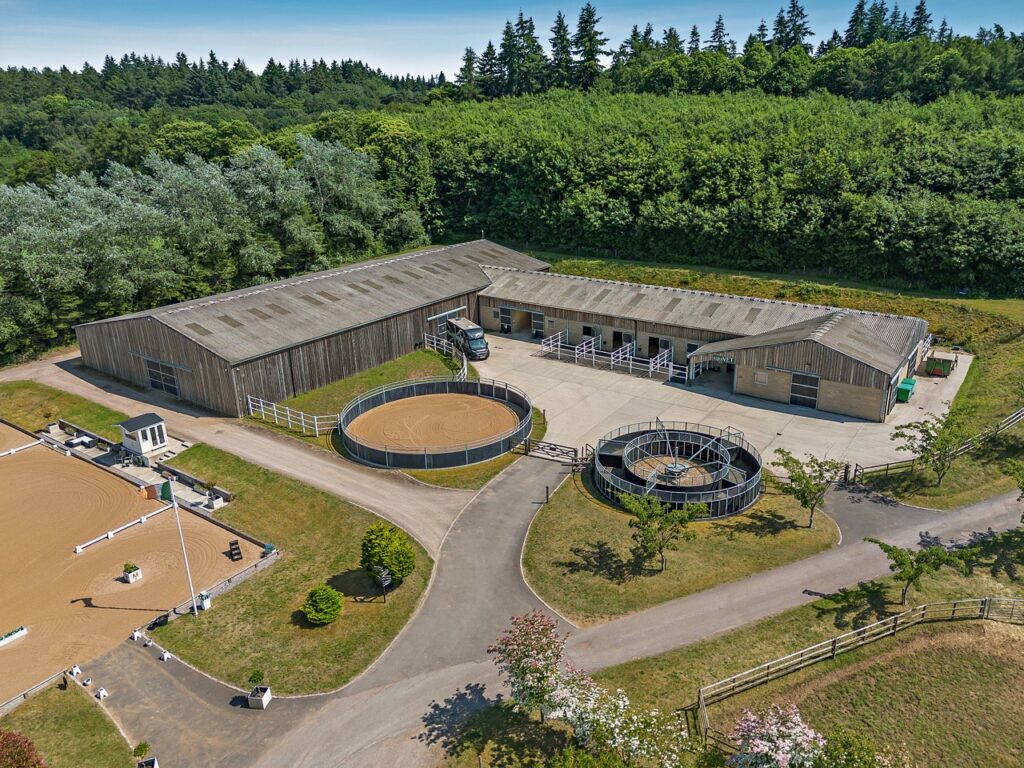
Nodwood House Equine

Nodwood House Equine in Farnham, Surrey, has some of the best equine training facilities in South East England, including indoor and outdoor arenas

The European benchmark for equestrian training yards

In Europe, it is standard to have everything under one roof: a large indoor school, often with viewing galleries, a judges’ box and a clubhouse, with indoor stables linked directly to it. Climate is part of the reason, so horses are not crossing ice or snow to reach a school. The prestigious German stable equipment manufacturer Röwer & Rüb has led the way in European state of the art equestrian facilities. That standard is arriving in the UK in a big way, and with it, a significant leap in the sophistication of the facilities.

So why now? Firstly, riders have seen it first-hand. Professionals are competing more widely on the equestrian world stages, travelling to various FEI Nation and World Cups, the Longines Global Champions Tour or the Winter Equestrian Festival in Florida, for example, or spending a few months training abroad. Inevitably, they come home wanting to reproduce what they have seen.

Why the main house is no longer the focus of professional super-yards

One of the biggest changes I see in equestrian trends is that, at the professional end, the focus has shifted somewhat away from the main principal house. The real draw is the equestrian facilities. These properties tend to need multiple dwellings: accommodation for a yard manager, alongside trainers and grooms living on site. Some visiting riders who base themselves at these yards for several months, training with three or four horses, may wish to rent a section of the yard for their exclusive use, bringing their own horsebox and, in some cases, a member of staff. To accommodate this, yards often provide self-contained flats or purpose-built staff accommodation close to the main yard and its facilities.

The set up of the training facilities themselves has also changed. A typical layout would incorporate a large indoor school with a clubhouse off it to act as the central point. The clubhouse is hugely important because it provides a hub – a large communal space with kitchen, dining and seating areas as well as a viewing area. Owners visiting to watch their horses train can do so in comfort, trainers and riders can analyse performance post-training, while a gym, shower facilities and even a physio treatment room are additional facilities. National Federations and elite pathway training squads will often hire these private super-yards such as Chedington Equestrian in Dorset or the Unicorn Equestrian Centre in the Cotswolds, ahead of major competitions for team training.

The main house now often isn’t near the equestrian facilities. On the more domestic equestrian property front, it is still seen as the dream to see your horses grazing out of the kitchen window, but in these super-yards, the focus is on separation and privacy. Easy access is important, but often the main house and equestrian facilities are accessed from different driveways or entrances.

What is driving demand for elite equestrian facilities?

At its heart, this shift is about money. Bloodstock has always generated huge sums, and that is now spilling into the sports horse world. Top show jumping, dressage and eventing horses change hands for fortunes, and breeding is big business. Very wealthy families are setting up exceptional stables and buying the best trainers and horses so their children can compete on the world stage.

The sport itself has professionalised alongside that investment. The Longines Global Champions Tour, started by Dutch Olympic gold-medal-winning equestrian Jan Tops, has done a huge amount here. Riders are paid to ride for teams over a season, rather like polo, and the events have the feel of Formula One, with podiums and fireworks, staged in places such as Miami Beach, Port Hercule in Monte Carlo, Cairo with the Pyramids as a backdrop, and in Paris in the shadow of the Eiffel Tower.

The prize money is big, but so are the pockets of the sponsors and owners. Showjumping has always been seen as a glamorous sport at the highest level, but with families such as the Jobs, Gates, Ecclestones, Springsteens, Abramovichs and Bloombergs involved as owners, investors and competitors, it is being elevated to another scale. Major investment from UAE countries has also fuelled the rise, with major sponsor Al Shira’aa heavily involved in UK and UAE events.

Pre-Olympic years bring their own pressure, and we are in one now. As LA 2028 approaches, the focus turns to combinations: teams are assembled, horses change hands, and the training begins in earnest. Federations bring squads together for pre-competition camps, with trainers, riders, physios and nutritionists in one place, and the facilities need to match. I have helped federations with this when overseas teams wanted somewhere to train in the UK for pre-Olympic camps. What professionals look for today is a level above that.
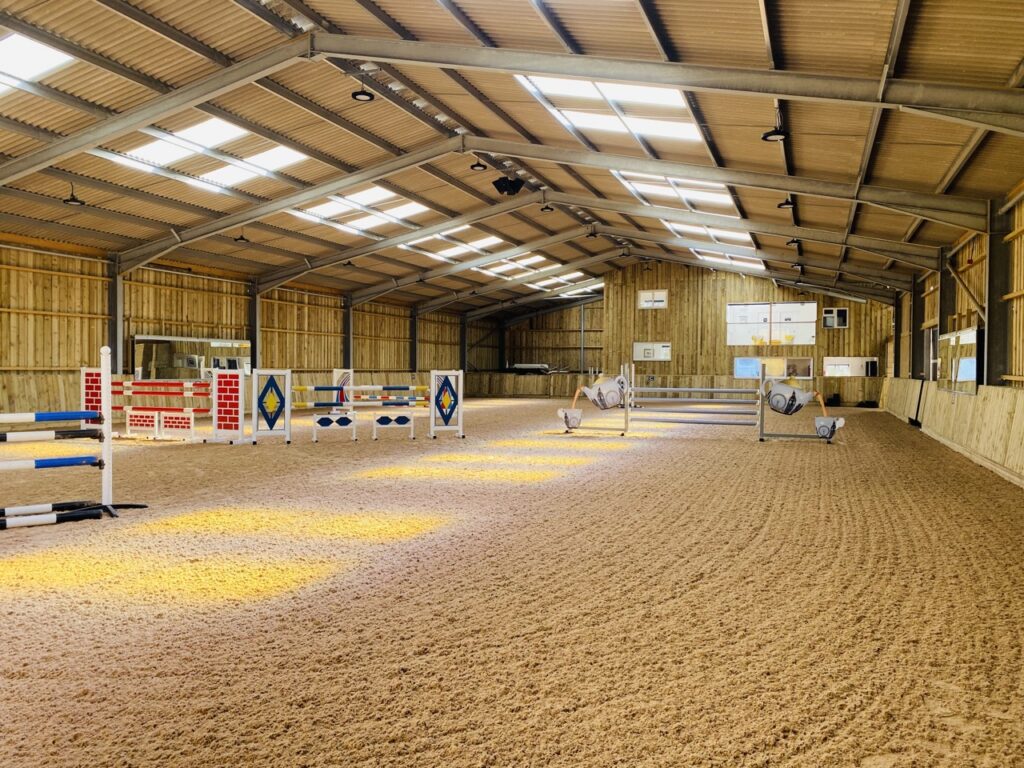
Nodwood Equine indoor training barn

The indoor training arena at Nodwood House

What it means for equestrian buyers and why specialist representation matters

The honest starting point is that these properties are extremely hard to find ready-made. Building such specialist complex facilities from nothing is complicated and lengthy – likely a five-year project – and needs specialist planning advice. 

My advice is to start with the footprint. That might be old agricultural buildings, or an equestrian establishment that needs updating. An existing indoor barn that could be enlarged, or a school that could be extended or covered, is especially valuable. Be careful, though: in some areas planning restrictions mean you simply will not get approval. I work with a specialist equestrian planning consultant who tells me he has never been busier, both in the UK and abroad.

Buying an equestrian property requires specialist advice from an experienced professional. There are many nuances between each of the disciplines and understanding the differences is key. Some require different types of land, different amounts of turnout, different layouts of yards. Understanding if will be run as a private yard or a commercial one is also important, as each has different rates applied, land classifications and planning regulations.

Having spent over 20 years advising equestrian clients from pony club families to Olympic teams, I am a recognised go-to equestrian buying agent and would love to help.

Woman in blue suit jacket with long brown hair looking at camera

Katherine Watters is our equestrian expert and specialist Partner for the Southern Home Counties

For news, expert commentary and invaluable property insight, subscribe to The Insider, our quarterly newsletter, here.
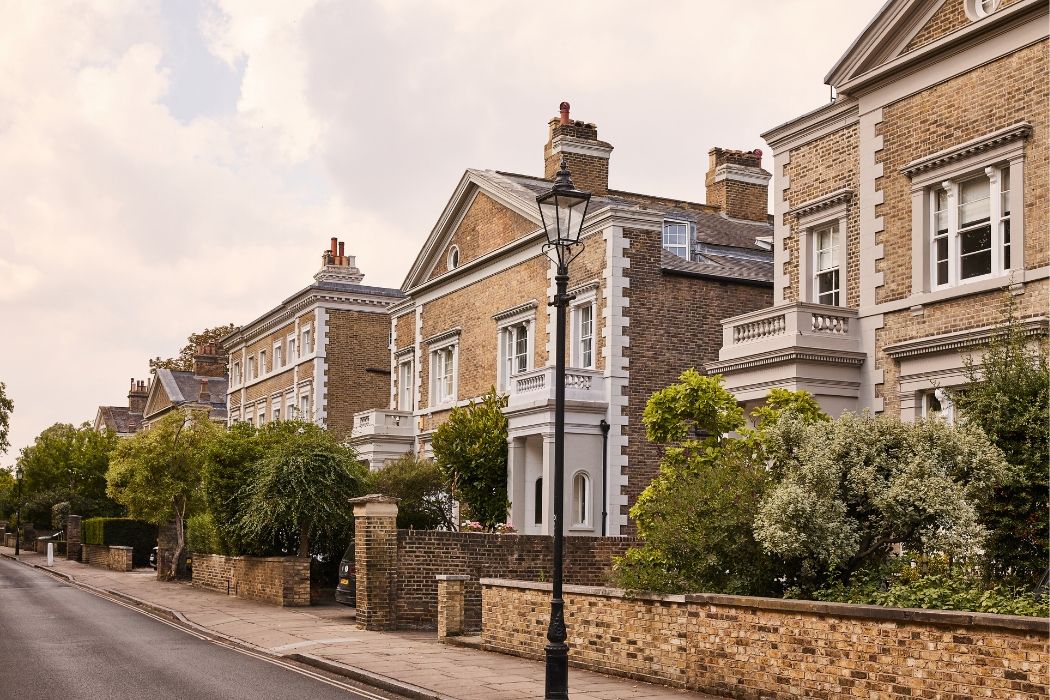
Why South-West London Property Prices Now Rival Central London

The best houses in Wimbledon Village, Richmond and Barnes are bought, refurbished, lived in for a generation, and many never reach the open market. Our Partner and south-west London specialist James Burridge reflects on what that scarcity now means for buyers and for the renovations that follow

The Buying Solution, Richmond, London. specialist Partner James Burridge
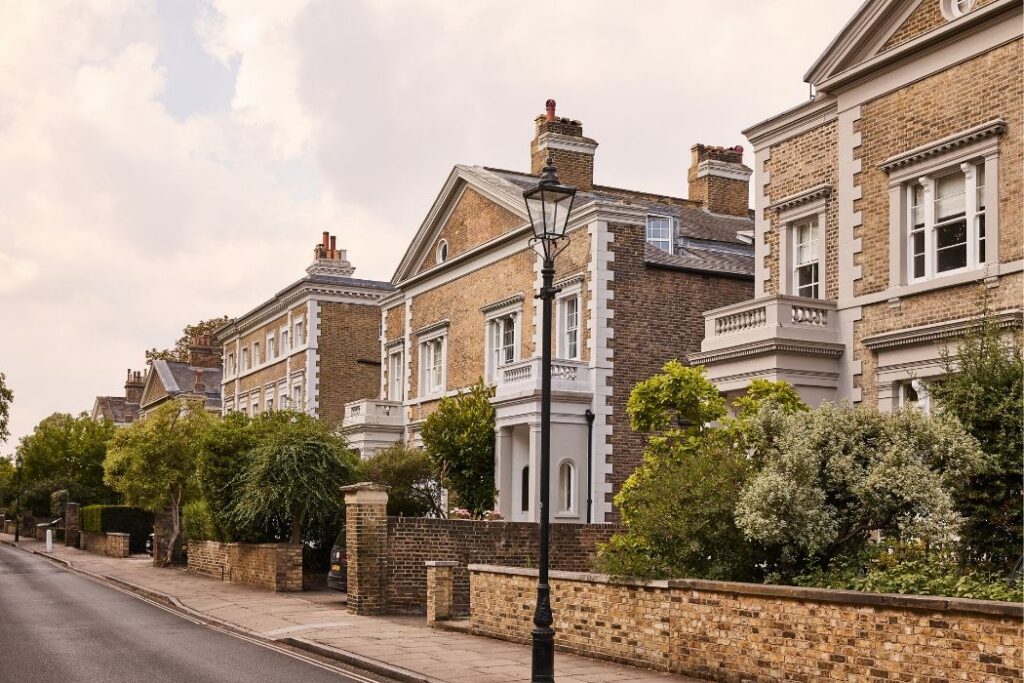
Richmond, London

In parts of south-west London, a house now costs as much as its equivalent in central London, and in some cases more. Not so long ago the idea would have been inconceivable, yet now Wimbledon Village, Richmond, Barnes and the better parts of Fulham are no longer the sensible alternative to Chelsea’s Kings Road. For many families, they are now the prime destination.

That reflects the growing appeal of this corner of London and the fundamental shift of how we now buy homes. A family’s property life once followed a comfortable script: you bought a two-bed flat, then a cottage, then a house, climbing the ladder as life demanded. Since stamp duty changed in 2014, the buyers I meet – domestic and international alike – tell me they must now live in the house for 10-15 years. So the home has to see a family through several life stages: too big at the start, about right in the middle, too big again at the end.

With so much riding on one purchase, people look hard at what £5 million actually buys. North of the river, it can get you a fairly tall, skinny house. Cross to Wimbledon Village, Wandsworth Common or Richmond and it buys something far wider and lower built, with a bigger garden, off-street parking and good schooling all around. Proximity to the Kings Road is no longer a necessity. A decent high street will do, with its coffee shops, high-end clothing stores and Waitrose, and a more village-like feel thrown in.

Why price per square foot is misleading

Of course, prime Notting Hill remains more expensive than Wimbledon Village, but parts of the lower end of the Kings Road and the better parts of Fulham are now drawing level on price. And people are paying a great deal for low, wide houses around Wandsworth Common, Wimbledon Common and Richmond Hill. £2,000 a square foot is no longer a high-water mark here.

Walk into a £5 million house in Paultons Square in Chelsea and you think, “Lovely, but I expected more.” Walk into a really good house two miles away on the Toast Rack – an enclave of grand late-Victorian and Edwardian townhouses and semi-detached properties near Wandsworth Common – and the difference is immediately apparent: in the width, the depth, the parking and a decent garden. Some pockets are now more expensive, but the quality of the homes is so much better.

Which is why getting hung up on the price per square foot is a fool’s errand, particularly as the figure is calculated on the house, not the garden. Value a house in Paultons Square with a 30-foot garden against one on Wimbledon Common with 150 feet of outside space, and the pounds per square foot will look similar. Yet there is a substantial value in that land which the number never captures. Look at the whole package, not just the house – the elusive off-street parking, the extra-large garden, a five-minute walk to the high street.

The question that matters most is repeatability. If we see a house like this just once a year, or even once every few years, it is very special indeed. If we see one once a quarter, it is rather less so. It’s a term that can be thrown around too lightly but these are generational homes. If someone buys a house on Marryat Road in Wimbledon Village, or Montague Road on Richmond Hill, refurbishes it and stays put, it may not become available again for 30 years.

The logjam within the prime London market

This brings me to the frustration that defines this market. Many long-standing owners bought in the 1980s or 1990s, their children have flown the nest and they are rattling around in a house they no longer need, yet there is little financial benefit in downsizing. Move from a £5 million house full of memories to a £3 million one, pay 12 or 13% stamp duty on the purchase, then refurbish, and there is not a huge amount left over.

The people who would trade up into those family houses are not able to unlock these special homes; it is a logjam at every level. These houses can sit in negative equity for a very long time, so now more than ever you cannot afford to get it wrong.

Even then, the house you want may never appear and above £5 million, properties generally do not reach the open market at all. They trade discretely and nobody knows they have come and gone. I estimate that around 75% of property over £3 million never hits the open market, of which a similar percentage need refurbishment.

That is why working with expert representation like ours becomes such a worthy investment. We unearth off market opportunities and undertake thorough due diligence to ensure the purchase is sound for years to come.

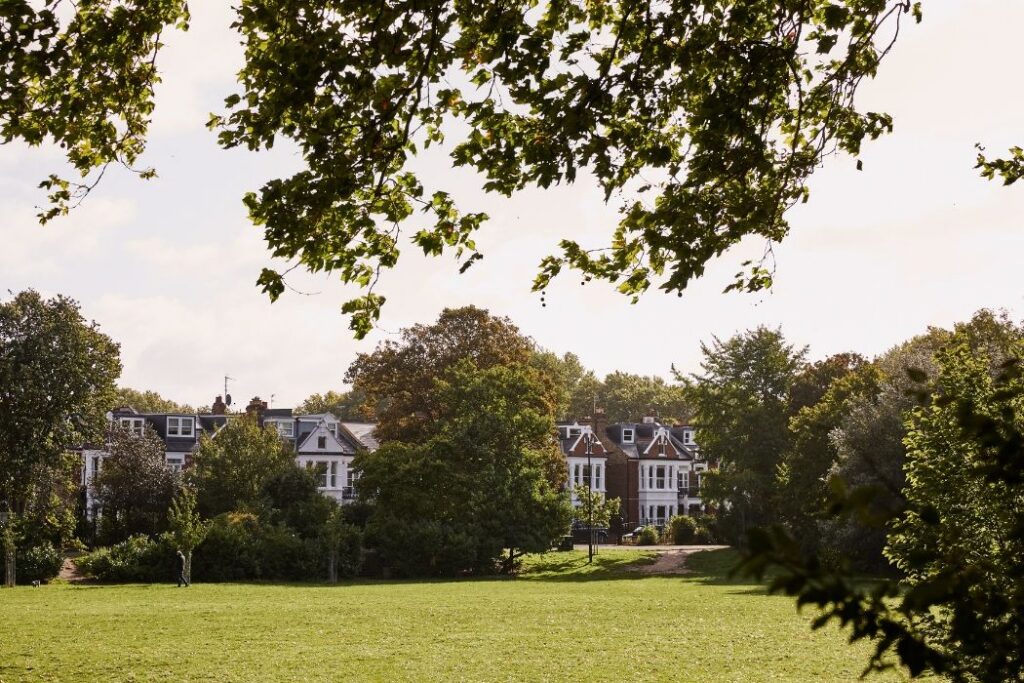
The Buying Solution, houses next to green open space in Fulham, London. Specialist Partner James Burridge
Fulham, London

Why being open-minded to a project pays dividends

Around 90% of clients begin their search by telling me they do not want a project. Perhaps 75% of those end up transacting on a home that needs updating. Turnkey houses do exist and command a premium of perhaps 10 or even 20%, but there are very few of them.

Look at 10 homes, find that seven need substantial refurbishment and none are truly turnkey, and the realisation lands that you have been limiting your search. Those who accept this earlier end up in their next home sooner.

The projects themselves can run from a new kitchen, bathrooms and redecoration at the minimum to replumbing, rewiring and digging basements. The topic growing fastest in refurbishment conversations is the requirement for air conditioning, which is now front and centre of almost every search.

Substantial works involve planning applications, architects and structural engineers and very few clients come with that depth of team. We can make those introductions to the most sought-after professionals, beginning with a project manager, an architect and a planning consultant, then building out to quantity surveyors and the rest. Having someone acting solely on your behalf who you trust helps enormously, and it gets people off the mark far quicker.

Timing is a lever too and very few people realise the lead times – with planning, detailed drawings, specification of works and tender, it is probably six months before a spade goes in the ground. So where we can, we negotiate a longer completion date, at which point the client has paid only a 10% deposit, but can put a planning application in and start the design and specification of works. Once you have completed, the house is empty and you are on the clock. This way, you hit the ground running.

In Barnes Village, we recently completed on a house for a couple with a young child who wanted to put down roots near friends and find a home they could stay in for the next 20 years. They will do a large ground floor extension and extend the first and top floors, which is likely a two-year project, so we delayed completion to let them organise as much as possible beforehand.

In Wimbledon Village, we bought a property last year for a client who was downsizing and wanted the village on her doorstep so she would not need the car. She has future-proofed the house by installing a lift, so she never has to move again. The purchase was an 18-month project, as the property had previously been divided into two flats, and we waited for the vendor to get permission to put them back together, which took the planning risk away.

Planning restrictions in prime south-west London

Many of the neighbourhoods I work in, such as Richmond, Wimbledon Village, Fulham and Barnes, contain some of the most architecturally significant conservation areas in south-west London. They are protected so that their historical character survives, which means that standard permitted development rights are tightly restricted.

Few properties are nationally listed, but many are locally listed or classed by the borough as Buildings of Townscape Merit (BTMs). So normal planning rules apply, yet scrutiny is much higher on external alterations such as replacing windows and front roof extensions.

How restrictive planning is depends on how far you push the envelope. On terraces and semi-detached houses, the tone of the road rules. If nobody has done a front mansard, do not even bother applying. Basements under terraces are also difficult to get approved as boroughs are very risk-averse. Larger detached houses with good depth, front and back, can push the boundaries more.

The evolution of the neighbourhoods I call home

I grew up in Wimbledon and now live in Fulham with my family, and the high streets have improved substantially in that time. Where once you may have had a Pizza Express you will now find the likes of Sticks’n’Sushi, The Ivy, even Scott’s – brands you would once have found only in the smartest parts of London.

The big occasions are marked a lot more extravagantly too. Wimbledon Village now looks little different from Holland Park at Halloween, with huge displays outside the houses. Before we had children, my wife and I used to tour the grandest neighbourhoods of central London on the back of my scooter every year to see the Christmas lights and displays. You no longer need to leave south-west London to do it!

All of which helps explain why families are putting down roots here, and why they do so with such care. A home that must carry you through several stages of life, in a market where exceptional houses rarely appear, leaves little room for error. Whether it is finding the house before it reaches the open market, accepting early that it will most likely need work, or having the right team in place by the time you complete, the aim is the same: to get it right first time, so that our clients can spend the next 20 years enjoying it.

James Burridge The Buying Solution

James Burridge is our specialist Partner in London

For news, expert commentary and invaluable property insight, subscribe to The Insider, our quarterly newsletter, here.