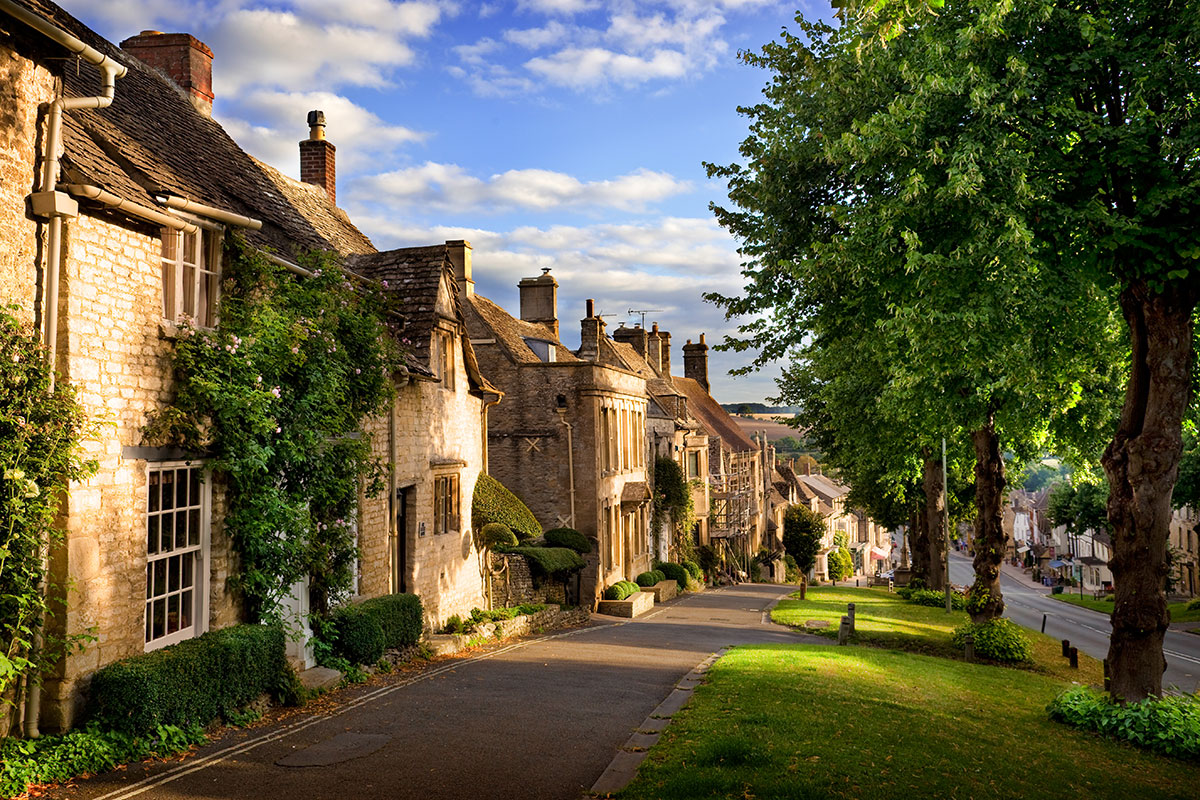
Prince Harry and Meghan’s return to the UK – and reported move to the Cotswolds – has further burnished the region’s crown. Writing for the Wall Street Journal, Ruth Bloomfield reports on how the area’s growing number of American buyers see it as the ultimate trophy asset, featuring insights from our Partner and Head of the Cotswolds, Harry Gladwin.
With the Duke and Duchess of Sussex settling their children into school and setting up their new home in the Cotswolds, the region’s appeal to American buyers is confirmed, writes Ruth Bloomfield in the Wall Street Journal. “I would say there has been a 25% increase in US buyers since last summer,” Harry Gladwin, our Partner and Head of the Cotswolds, shares in the article. “The Cotswolds is now an international brand.”
Parents hoping to move house for a school catchment area are learning a hard truth: timing is everything. Writing in The Telegraph, Ruth Bloomfield explores what it really takes to land a spot at the best state schools – including advice from our own Cotswolds buying agent, Georgina Neil, on getting the move right.
Competition for places at good state schools is fierce – and for the best houses in their catchment areas, fiercer still, especially since VAT was introduced on private school fees, reports Ruth Bloomfield in The Telegraph.
To keep the move as stress-free as possible, early research pays off. “For a September start, we would generally advise beginning the process during the previous autumn or winter, to allow sufficient time for finding the right property, agreeing a sale, and navigating the conveyancing process,” advises Georgina Neil, our Cotswolds buying agent, in the article.
Large country houses not in use by their owners were traditionally mothballed. Not anymore, writes Eleanor Doughty in Country Life, with insights from Katherine Watters, our Partner and Southern Home Counties expert.
For those with multiple large country houses, deciding what to do with the one you weren’t occupying used to be simple: the dust sheets came out and you mothballed it until your return. But now, owners tempted by the handsome returns that short lets can yield are seeing their properties as business assets, writes Eleanor Doughty in Country Life.
‘In the times we’re in, people look at what they’ve got and think how can they make some extra income from it,’ comments Katherine Watters, our Partner and Southern Home Counties expert.
The post-Covid frenzy may be over, but reports of the Cotswolds property market cooling are greatly exaggerated, writes Harry Gladwin, our Partner and Head of the Cotswolds. For buyers, the challenge now is not demand but scarcity.
It is a particularly British trait – especially in the property press – to cast things as either fantastic or dreadful, with everything in between deemed of little interest. I suspect that polarised approach informed some of the reports over the summer suggesting that the so-called Cotswolds property boom was over.
Reports of falling farmhouse values across Oxfordshire and Gloucestershire were presented as evidence that the Cotswolds’ halcyon days had come to an end. But a correction is not the same thing as a collapse. The fundamental appeal of the Cotswolds has not changed; what has is the unrealistic levels of expectation that built up around its property market during the pandemic.
The post-Covid property boom was an anomaly
In the extraordinary period following the pandemic, demand for Cotswolds property surged to levels the market had never experienced. Buyers, especially those from London liberated from the office and newly focused on space, landscape and quality of life, competed for a finite supply of houses.
As a result, properties that might once have attracted modest interest were suddenly commanding substantial premiums. Asking prices became increasingly detached from precedent, and speed became a virtue in itself. Scarcity and urgency often blurred the distinction between a genuinely exceptional house and an ordinary one in a desirable location.
As time wore on, many sellers held on to unrealistic ideas of what their properties were worth. The softening of prices for property which had, in truth, been overpriced is not evidence that the Cotswolds itself has fallen out of favour. It hasn’t.
The post-Covid market was an anomaly, not a new benchmark. What we are seeing now is a return to a market that is more sophisticated and discerning. Buyers are looking much more carefully at quality, condition and whether the price is justified. For me, that represents a much healthier market.
Best-in-class houses are still selling extremely well and commanding a premium. There simply aren’t enough of them to satisfy demand. Properties with compromises are having to find a more realistic level, while those that are overpriced are increasingly being left behind. This is what a functioning market looks like.
The Cotswolds still has a supply problem
The Cotswolds remains one of the UK’s most supply-constrained prime residential markets and it’s tricky to find a good house now that is available to buy. Many of the people who own the most desirable houses in the area have little reason to sell. They like it here, and where else would they go?
That creates an apparent contradiction for buyers. The market may be more rational than it was three years ago, but it is not necessarily easier to enter. For a high-value buyer coming from London or overseas, particularly one comparing the Cotswolds with softer markets elsewhere in the UK, the lack of available stock can be difficult to reconcile with the prices being asked for what is available. It comes back to the issue of supply and demand.
The real Cotswolds property market is not always visible
This is where the distinction between the visible market and the real market becomes important. Property portals and magazines such as Rightmove and Country Life show what is openly being offered for sale but not what might be available through relationships, local knowledge or conversations with owners who have never formally instructed an agent.
For buyers operating at the upper end of the market, this is precisely where specialist advice becomes invaluable. My role is not simply to identify the best houses, but to understand and interpret the market they are being offered in. The differences between villages, knowing the owners who may genuinely consider selling, the opportunities unlikely to be widely marketed and, crucially, whether a property represents good value before emotion takes over. Judgement matters just as much as access.
International demand for Cotswolds property remains strong
The Cotswolds has always been an internationally recognised brand, attracting people from London and further afield. That is not new. What the pandemic did was amplify it.
The suggestion that interest in the Cotswolds is waning also underestimates the breadth of the market itself. The traditional family buyer remains a powerful force, drawn by schooling, accessibility from London and quality of life. Demand for leading schools in the region and surrounding areas remains an important part of the equation.
At the same time, the international market has deepened considerably. American buyers now account for 25–30 per cent of our Cotswolds client base, alongside buyers from the Middle East, Switzerland and elsewhere in Europe.
Sarah Frances Kelley for The Buying Solution
Why the Cotswolds’ popularity is not a bad thing
I also think there is a tendency to confuse increased visibility with overexposure. Certain parts of the Cotswolds have undoubtedly become more prominent, particularly in the five-mile radius around Daylesford and Kingham and places such as Estelle Manor and Soho Farmhouse, which have created their own micro-climates of hospitality, food and leisure. But the Cotswolds is a huge area from a UK point of view, and typically our buyers would look to avoid or be outside the obvious touristy areas that are getting most of the publicity.
I don’t see increased popularity that as a dilution of the Cotswolds’ appeal. If anything, it has made the region more diverse. The Cotswolds is large enough to offer very different versions of country life. For some, proximity to good restaurants, hotels and social life is part of the attraction; for others, the appeal lies in being well away from it. People can choose the version that suits them.
More broadly, I see the investment that has accompanied the Cotswolds’ growing profile as overwhelmingly positive. Businesses such as Daylesford Organic and the individuals behind them have invested heavily in the region, creating jobs and opportunities for local people, as well as places for them to visit, eat at and enjoy. It is shortsighted to see increased popularity as inherently negative.
Cotswolds buyers are becoming more selective
The fundamentals underpinning demand have therefore remained remarkably consistent. The schools are still pulling families here. London remains accessible. The landscape has lost none of its appeal. And the lifestyle is probably as good as it gets outside London.
What has changed more noticeably is what buyers are prepared to take on once they have found a house. The appetite for major refurbishment has cooled considerably. Materials are more expensive, skilled labour is harder to find, Planning is challenging and so projects take longer.
The romantic proposition of buying an unloved country house and transforming it looks rather different once the first contractor’s estimate arrives. Except where they represent a genuinely rare opportunity, projects are becoming harder to sell.
There is also a significant disconnect between what some sellers believe refurbishment should cost and what it actually costs today. For an owner who has not undertaken a major project for 20 or 30 years, it is easy to underestimate how dramatically the economics have changed. Once buyers understand the true cost of renovation, many simply cannot justify taking it on.
That is increasingly being reflected in value. A house requiring substantial investment cannot be assessed simply on its underlying charm or potential. The cost, duration and complexity of a renovation in the Cotswolds needs to be understood and reflected in the price.
Why local knowledge matters when buying in the Cotswolds
The challenge for a buyer is no longer simply to find a property. It is to understand what is genuinely rare, what is fairly priced and what only appears attractive because the supply of alternatives is limited.
Scarcity can be a powerful psychological force. After searching for months, perhaps years, it is easy to convince yourself that a house is worth buying because it is the first vaguely suitable one to appear.
But a lack of alternatives should not, in itself, justify compromising on quality or paying an unjustified premium. An experienced buying agent should provide the perspective that is hardest to maintain when you are emotionally invested.
Is this genuinely rare, or merely rare at this price? Is the location exceptional? Are the compromises manageable? What will the house actually cost to own and improve? And, if you decide not to buy it, what is likely to come next?
In a market where the best houses are scarce, knowing what not to buy in the Cotswolds is just as valuable as knowing what to buy.
Harry Gladwin is our Partner and Head of the Cotswolds Region
For news, expert commentary and invaluable property insight, subscribe to The Insider, our quarterly newsletter, here.
We use cookies to improve user experience and analyze website traffic. By clicking “Accept,” you agree to our website’s cookie use as described in our Cookie Policy.
This website uses cookies to improve your experience while you navigate through the website. Out of these, the cookies that are categorized as necessary are stored on your browser as they are essential for the working of basic functionalities of the website. We also use third-party cookies that help us analyze and understand how you use this website. These cookies will be stored in your browser only with your consent. You also have the option to opt-out of these cookies. But opting out of some of these cookies may affect your browsing experience.
Necessary cookies are absolutely essential for the website to function properly. These cookies ensure basic functionalities and security features of the website, anonymously.
Cookie
Duration
Description
cookielawinfo-checkbox-analytics
11 months
This cookie is set by GDPR Cookie Consent plugin. The cookie is used to store the user consent for the cookies in the category "Analytics".
cookielawinfo-checkbox-functional
11 months
The cookie is set by GDPR cookie consent to record the user consent for the cookies in the category "Functional".
cookielawinfo-checkbox-necessary
11 months
This cookie is set by GDPR Cookie Consent plugin. The cookies is used to store the user consent for the cookies in the category "Necessary".
cookielawinfo-checkbox-others
11 months
This cookie is set by GDPR Cookie Consent plugin. The cookie is used to store the user consent for the cookies in the category "Other.
cookielawinfo-checkbox-performance
11 months
This cookie is set by GDPR Cookie Consent plugin. The cookie is used to store the user consent for the cookies in the category "Performance".
viewed_cookie_policy
11 months
The cookie is set by the GDPR Cookie Consent plugin and is used to store whether or not user has consented to the use of cookies. It does not store any personal data.
Functional cookies help to perform certain functionalities like sharing the content of the website on social media platforms, collect feedbacks, and other third-party features.
Performance cookies are used to understand and analyze the key performance indexes of the website which helps in delivering a better user experience for the visitors.
Analytical cookies are used to understand how visitors interact with the website. These cookies help provide information on metrics the number of visitors, bounce rate, traffic source, etc.
Advertisement cookies are used to provide visitors with relevant ads and marketing campaigns. These cookies track visitors across websites and collect information to provide customized ads.